

New Archaeological Discoveries at Xiaomintun, Yinxu
The Xiaomintun site is located at the western periphery of the Yinxu complex. 220,000 square meters in dimension, it is comprised of the southern and northern parts. In history the site has suffered from agricultural and residential activities of the local populations. In the 1970s the Institute of Archaeology of Chinese Academy of Sciences performed some small-scale excavations in this site and came across bronze-casting remains and some small Shang burials. In the period from April of 2004 to May of 2005, the joint archaeological team of the Institute of Archaeology of Chinese Academy of Social Sciences and the Institute of Cultural Property and Archaeology of Henan Province, in the prospect of a construction project of the Anyang Steel Company, exposed 60,000 square meters in this site. The major moments of this excavation are as follow:
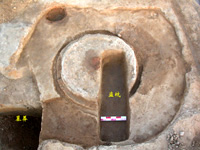
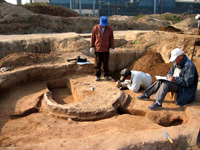
1. Discovery of a complete bronze-casting foundry of the Shang dynasty in the southern part of the site. The foundry measures 370m east to west and 130m north to south, and 48,000 square meters in dimension. The major finds are earth-quarrying pits, clay-refining pits, clay-storing pits, molds-drying pits, storage pits, workshops for making large bronze vessels and casting platforms, wells, and cemeteries of casters, as well as refuse of bronze production. The melting furnaces and crucibles are mostly in the fragmented form. Casting molds, in great quantity, include both the outer molds and inner molds. They are delicately produced with exquisite and fine ornaments, and sometimes even a few characters. These molds indicate that this workshop was producing primarily ding-tripods, gui, gu and jue, but also lei, zun, you, gong, dou, yi, li and you-lid in the animal form, and less often weapons. Among the ding-tripod forms, the circular ding-tripod type predominates over the rectangular type, with 25-40cm in diameter. Three casting workshops for large bronze vessels are found here, all semi-subterranean structures with casting platforms in the central part. The well-preserved one has a bottom part of an inner mold for a large bronze vessel. The diameter of this mold is 1.58m, which means that the workshop once produced a huge vessel with a diameter of 1.58m inside. In another workshop, in the fill are found two abandoned un-baked clay molds for ding-tripod legs, 13-17cm in diameter and 45cm in length. One mold bears relief of the tao-tie design with recognizable brows, eyes, and background designs. The mold-drying pits are either rectangular or circular in plan, with upright walls and flat bottoms. The bottoms of these pits, over 2m underground, are paved with charcoal.
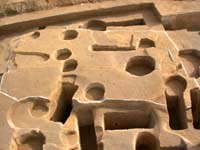
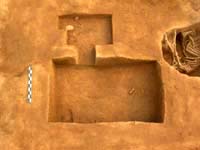
2. Discovery of 135 structures/complexes. Among them 131 are of the Shang dynasty. These include 6 large-scale, 25 small-scale, 100 semi-subterranean structures/complexes with over 200 rooms, all of which date to Phase II of Yinxu. They are distributed in four groups, with one in the northern part and three in the southern part. The best-preserved group consists of 27 sets/complexes with 70 rooms, which are arranged in an east-west line. These sets/complexes occur in one-, two-, three-, and four-room formats; each has an earth platform, possibly kang—heated bed, and a fireplace for cooking and heating. Many rooms hold utilitarian vessels, and some accommodate tortoise shells for divining activities.
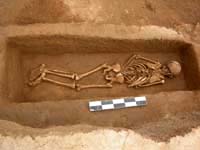
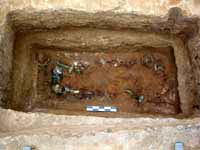
3. Discovery of 1276 burials. Among them 1000 are of the Shang dynasty, mostly of Phases III and IV, but a few of Phases I and II. Inside the burial pits are found wooden coffins, mattress, and animal hide, as well as gu and jue vessels. Of great interest are decorated textile (s) and groups of coffin-related postholes found in the burials.
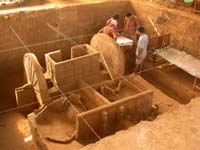
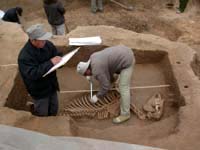
4. Discovery of sacrificial structures of the Shang dynasty. These are ditches and pits with human sacrifices, and pits with sacrifices of pig, cattle, horse, vehicle, and sheep. They are associated with structural foundation, burials, and production activities such as bronze casting. The ditches containing human sacrifices are in the concentric form, 30m per side, with an opening in the south. Human sacrifices, mostly found in the northern section, were killed before being buried. A majority of the bodies are merely trunks without heads. They were laid supine, prone, and on one side; some even had their arms bound. The cylindrical pit J6, almost 8m in depth, has sacrifices of human and pig in five layers, with 4 human bodies on the bottom and 4 pigs in the fourth layer. The eastern one of the two pits to the south of the foundry accommodates 2 humans and over 100 jaws of cattle with all teeth removed, which are placed in two layers with about 60 items each; the western pit contains a few jaws of cattle, but 3700 teeth of cattle, which seem to have been dumped here.
5. Discovery of 1189 refuse pits. Most of them are of the Shang dynasty, particularly of Phases III and IV. Some are storage pits with spiral steps.
6. Collection of thousands of artifacts. Most of them come from burials. The materials of these artifacts are gold, bronze, iron, jade, stone, pottery, porcelain, bone, horn, teeth, clam shell, lead and lacquer. Among them are one hundred small bronze ritual vessels like ding-tripod, gui, you, li, gu and jue, and about 250 weapons and tools.
7. The human skeletons uncovered from the burials have been studied, documented and collected by anthropologists. In the meantime a great number of vegetable samples have been obtained by sifting soil samples from hundreds of excavation points.
The group of semi-subterranean residential structures is the first discovery of its kind in the Yinxu complex, providing fresh material for studying the life of low-class people of the Shang dynasty. The bronze foundry equally offers new data for studying the bronze production of this period. The find of the sacrificial ground indicates that sacrificial activities also took place in the peripheral areas of the Yinxu complex.