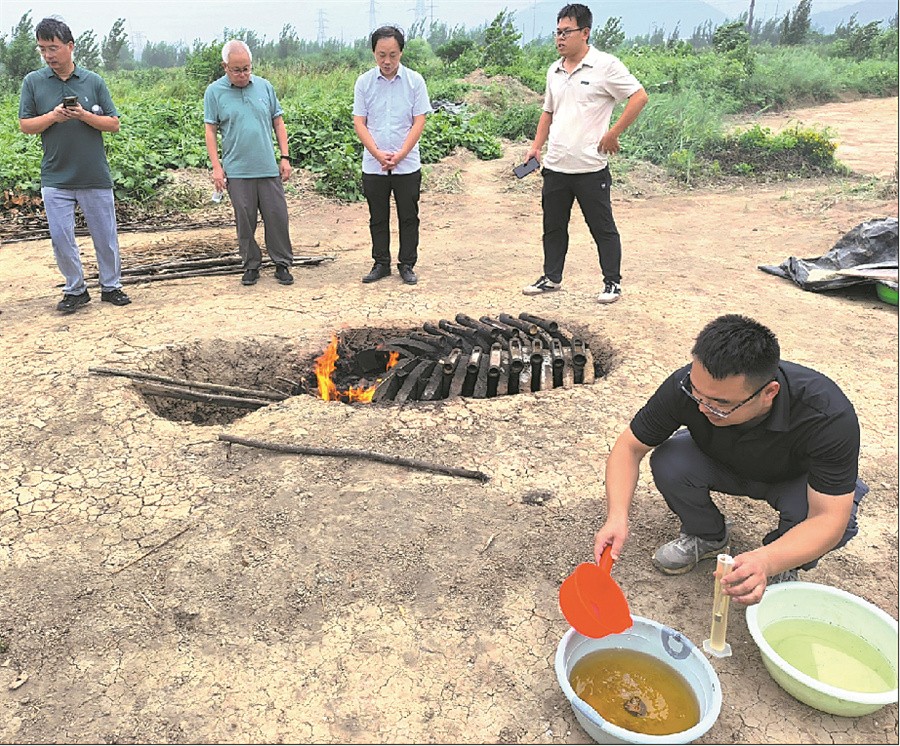
Archaeologists reenact the salt boiling process at the Lizhuang site in Lianyungang. [Photo provided to China Daily]
On the shores of the Yellow Sea, the Lianghuai region, straddling the Huaihe River, was one of ancient China's most important salt-producing zones from the Han Dynasty (206 BC-AD 220) onward. Its output was more than a valuable commodity — it underpinned the economy and became a major source of imperial tax revenue.
For centuries, the scale and sophistication of this industry were known only through historical records. In recent years, however, archaeology has begun filling in the missing pieces, revealing a far richer picture. Nowhere is that clearer than at a cluster of newly identified production sites along the coast of eastern Jiangsu province, recently released by the National Cultural Heritage Administration.
Since 2022, archaeologists from Jiangsu have investigated a series of sites, forming a complete sequence of salt-related sites from the Neolithic period more than 4,000 years ago to the Warring States Period (475-221 BC). The discoveries establish an unbroken archaeological sequence for the region and fill major gaps in the study of pre-Qin Dynasty (221-206 BC) production, says project leader Zhou Runken of the Jiangsu Provincial Institute of Cultural Relics and Archaeology.
Each site adds a new chapter to the story. The Zhenhai site in Lianyungang preserves production facilities dating back more than 4,000 years, including stoves, processing pits and waste-disposal areas. The Hulushan site, also in Lianyungang, unveils Shang Dynasty (c. 16th century-11th century BC) salt-making facilities.
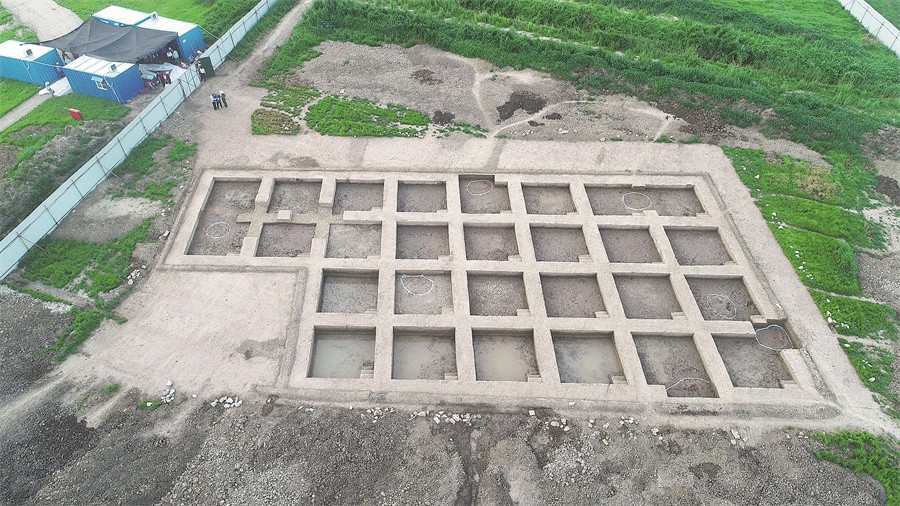
The Hulushan site in Lianyungang, Jiangsu province, yields Shang Dynasty (c. 16th century-11th century BC) salt-making facilities. [Photo provided to China Daily]
Zhou says the nearby Dacun site has yielded a collection of Shang bronze vessels, while the Kongwangshan site, not far from Hulushan, has produced Shang tombs.
Together, these discoveries suggest the Hulushan industry may have formed part of a broader Shang strategy to extend influence along the eastern coast and secure reliable access to marine resources.
The findings echo earlier discoveries elsewhere along China's eastern seaboard.
"About two decades ago, we investigated why the Shang expanded eastward, based on high-status tombs and bronze artifacts found at the Daxinzhuang and Subutun sites in present-day Shandong province, also on China's east coast," says Chen Xingcan, a veteran archaeologist at the Chinese Academy of Social Sciences.
"These new discoveries in the coastal area of eastern Jiangsu provide another important clue: gaining control of this vital resource may have been a key strategic driver behind that expansion."
The research has also highlighted striking regional differences.
Archaeologists found that before the Qin Dynasty, producers in Jiangsu used thick-walled red pottery plates or basins supported by ceramic stands as boiling vessels. By contrast, the distinctive helmet-shaped pottery associated with contemporary production sites along the southern coast of the Bohai Sea in Shandong has not been found in Jiangsu.
"This shows that Jiangsu and Shandong developed two distinct coastal production systems during the pre-Qin period," Zhou says.
Research into the Han Dynasty has produced equally significant results. At the Shizhuang site in Lianyungang, archaeologists uncovered an entire production chain, from extracting and concentrating brine to transporting it through ceramic pipelines into storage pits where it was boiled over stoves.
Another major discovery came from the Shajingtou site in Yancheng, Jiangsu, where the remains of a Han-era administrative complex were unearthed along with official seals. According to Zhou, the finds provide tangible evidence for historical records that the county of Yandu was established to oversee local production and trade.
"The discovery is of great significance," says Chen.
"For years, we had found very few related sites in Jiangsu. Now we have a continuous sequence from the Neolithic era to the Warring States Period, as well as an administrative headquarters from the Han Dynasty. That would have been unimaginable not long ago.
"I believe this is only the beginning. More discoveries are almost certainly waiting to be made," he adds.