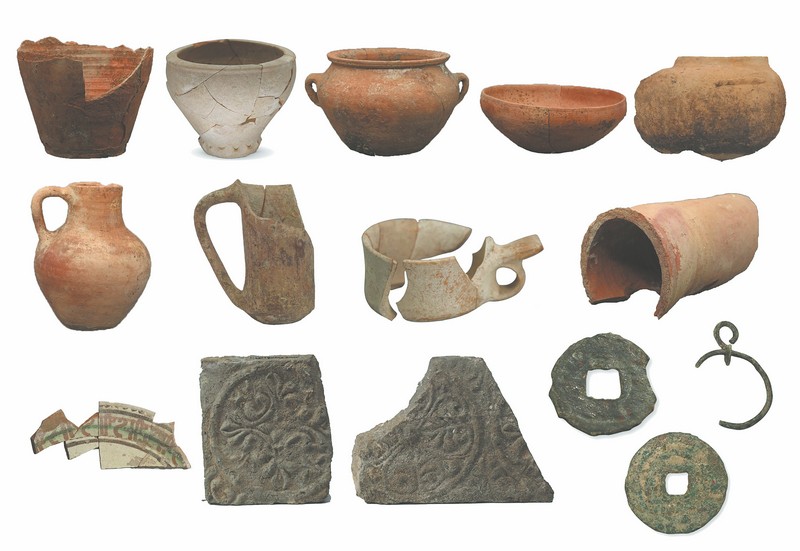
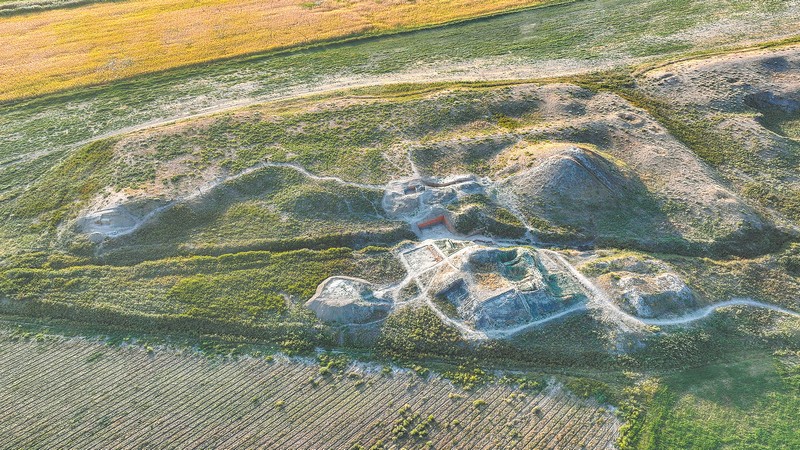
Objects found at the Krasnaya Rechka site in Kyrgyzstan. CHINA DAILY
More than 1,000 years ago, Tang Dynasty (618-907) Buddhist monk Xuanzang traveled through what is now the Chu River Basin in Central Asia. In The Great Tang Records on the Western Regions, he described a land where merchants from many countries gathered, grapes grew, trees were sparse, and the climate was cold and windy. He noted that local people dressed in felt and coarse linen.
Today, archaeology is shedding new light on this historic region. Since 2018, the Shaanxi Academy of Archaeology has worked with the Institute of History, Archaeology and Ethnology of the National Academy of Sciences of the Kyrgyz Republic to investigate the Krasnaya Rechka site in Kyrgyzstan.
Located in the Chuy Valley in the eastern part of the Chu River Basin, the site lies along a key corridor of the ancient Silk Road that linked China's Xinjiang Uygur autonomous region with West Asia. Scholars widely identify it as Navekat, an ancient city mentioned in Sogdian and Muslim literature and referred to in Tang Dynasty records as Xincheng, meaning "New City". Founded by Sogdian people in the 6th century, the city was abandoned in the early 13th century.
In 2014, the site was included in the UNESCO World Heritage property Silk Roads: the Routes Network of Chang'an-Tianshan Corridor.
Shao Jing, deputy director of the Shaanxi Academy of Archaeology, says the Chuy Valley was historically significant. Suyab, the ancient city where Tang Dynasty poet Li Bai may have been born, and Xincheng both feature prominently in historical Chinese records. They are associated with the valley and its surrounding region. This historical importance helped make Krasnaya Rechka a focus of archaeological research.
Chinese and Kyrgyz archaeologists collaborate on excavating the site, which lies along a key corridor of the ancient Silk Road. CHINA DAILY
Shi Yanxin, head of the Chinese team in the joint project, says the site occupies an important place in Central Asian archaeology. Since its discovery more than 130 years ago, researchers have made considerable progress in studying it. However, its overall layout remains poorly understood, leaving important questions for further investigation.
Covering about 2 square kilometers, the site comprises five major areas: the castle and the northern, eastern, western, and outer city areas. The joint archaeological team has concentrated its work on the western city area.
Chinese specialists have used LiDAR remote sensing to create a digital elevation model and map the site's boundaries with precision. Building on this work, they also established a digital archaeology information platform for the Chuy Valley.
"Remote sensing is particularly useful in Central Asian archaeology. In China's big cities, it's hard to use because intensive human activities often disturb traces of ancient remnants. But many parts of Central Asia are sparsely populated, with few modern buildings. On satellite images, the outlines of ancient sites can be clearly seen," says Wang Wei, a veteran archaeologist with the Chinese Academy of Social Sciences.
The team's research has revealed that the western city area is roughly square when viewed from above and covers about 0.39 square kilometers. Its walls are discontinuous, and buildings are relatively sparse, with most concentrated in the western part of the area.
Shi says the team also excavated a large building in the western city area to investigate its structure and building techniques. More than 20 tombs, pits and house foundations have been identified west of the building.
The excavations have yielded more than 100 cultural relics, most dating to the Kara-Khanid Khaganate, which ruled parts of Central Asia from the 9th century to the early 13th century.
Valery Kolchenko, the Kyrgyz head of the joint archaeological team, says the site yielded Tang Dynasty coins from China, artifacts bearing Sogdian inscriptions, Buddhist structures, and Nestorian Christian tombs.
"The site lay at a crossroads, where diverse cultures and religions converged and integrated," he says.
Beyond Krasnaya Rechka, the team conducted archaeological surveys of ancient city sites across the Chu River Basin, and identified 24 sites. The findings suggest that cities in the Chuy Valley and the nearby Issyk-Kul region flourished between the 8th and 12th centuries.
"When we see our Chinese colleagues coming from afar, respecting our customs and culture, and exploring Kyrgyzstan's past alongside us, we realize that this wonderful relationship can contribute to peaceful development," Kolchenko told People.cn.
"This connection is not based on money, but on culture and beautiful things," he added.