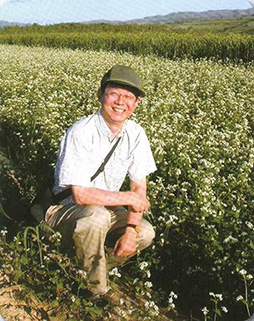
Biographical Profile
Zhao Zhijun, male, was born in Xi’an, Shaanxi Province in 1956. From 1978 to 1982, he studied archaeology at the Department of History, Peking University, where he obtained a Bachelor’s Degree in History. From 1982 to 1985, he was assigned to Cultural Relics Publishing House in Beijing, serving as a book editor. From 1985 to 1988, he joined the military and worked as an exhibition editor at the Military Museum of the Chinese People's Revolution.
In 1989, he went to the United States for further studies, majoring in paleoethnobotany at the Department of Anthropology, University of Missouri, and earned his PhD in Anthropology in 1996. From 1997 to 1998, he conducted postdoctoral research at the Smithsonian Tropical Research Institute.
He returned to China in 1999 and took up a position at the Institute of Archaeology, Chinese Academy of Social Sciences (CASS). He has served as Deputy Director and then Director of the Archaeological Science and Experimental Research Center of the Institute, Research Fellow and Doctoral Supervisor.
Major Work
After returning to China, he introduced paleoethnobotany to the Chinese academic community through publishing papers, delivering lectures, and developing as well as imparting relevant techniques at excavation sites. In collaboration with other colleagues, he helped establish and refine the research system of paleoethnobotany in China.
He has presided over a number of scientific research projects, including those funded by the U.S. National Science Foundation, the National Natural Science Foundation of China, the Major Research Projects of the Chinese Academy of Social Sciences, and the Science and Technology Research Projects of the National Cultural Heritage Administration. He was also one of the principal investigators of the environmental research component under the "Project for Exploring the Origins of Chinese Civilization", a national science and technology support program.
His research focus lies in the origin of agriculture, particularly the emergence and early development of rice farming in southern China and dryland farming in northern China. He has also conducted research on primitive agriculture in the tropical regions of Lingnan, and based on these studies, proposed a new theoretical model of three parallel lines of development for the origin of primitive agriculture in China.
In addition, he has dedicated himself to the study of ancient agriculture in relation to the origin of Chinese civilization, putting forward a series of original insights into the interactive relationship between the formation of Chinese civilization and the development of ancient agriculture.
Major Achievements
•The Middle Yangtze Region in China is One Place Where Rice was domesticated: Phytolith Evidence from the Diaotonghuan Cave, Northern Jiangxi. Antiquity 72: 885-897.1998.
•Late Pleistocene/Holocene Environments in the Middle Yangtze River Valley, China and Rice (Oryza sativa L.) Domestication: The Phytolith Evidence. Geoarchaeology 15 (2): 203-222. 2000(与 Dolores R. Piperno 合著).
•Zhao Zhijun. 2001. "The Disciplinary Orientation and Research Content of Archaeobotany". Archaeology, No. 7.
•Zhao Zhijun. 2004. "Floatation: A Paleobotanic Method in Field Archaeology". Archaeology, No. 3.
•Zhao Zhijun & Junko Namba (Japan). 2004. "The Origin of Early Agriculture in China—The Origin and Spread of Rice Farming" [in Japanese]. Kodai Bunka (Ancient Culture), Vol. 56, No. 1.
•Zhao Zhijun. 2004. "A Discussion on the Origin of Dryland Agriculture in Northern China Based on Flotation Results from the Xinglonggou Site", in Ancient Artefacts of East Asia (Volume A). Cultural Relics Press.
•Zhao Zhijun. 2006. "A Re-understanding of Primitive Agriculture in South China", in Prehistoric Archaeology of South China and Southeast Asia. Cultural Relics Press.
•Zhao Zhijun. 2007. "A Study on the Agricultural Economy in the Central Plains from 2500 BCE to 1500 BCE", in Scientific and Technological Archaeology (Volume 2). Science Press.
•Zhao Zhijun. 2009. "Identification and Analysis of Plant Remains Unearthed from Pottery Granaries of Han Dynasty Tombs in Xi'an" [in Japanese]. Shin Yayoi Jidai no Hajimari (The Dawn of the New Yayoi Period), Vol. 4. Yuzankaku Press.