CONTENTS
Foreword / Chen Xingcan
Similarities between Cucuteni-Tripolye Painted Pottery and Chinese Prehistoric Painted Pottery / Li Xinwei
Cucuteni Culture: A General Introduction / Cornelia-Magda Lazarovici, Gheorghe Lazarovici, Lăcrămioara Stratulat
Part One: Cucuteni Culture Period A
Cucuteni Culture A2
Cucuteni Culture A3
Cucuteni Culture A4
Part Two: Cucuteni Culture Period A-B
Cucuteni Culture A-B1
Part Three: Cucuteni Culture Period B
Cucuteni Culture B1
Cucuteni Culture B2
Part Four: Introduction to Artifacts
Bibliography
Postscript
FOREWORD
In 1921, Johan Gunnar Andersson (1874-1960), a Swedish geologist and archaeologist employed by the Chinese government as a researcher at the Geological Survey of China, identified the existence of China’s first prehistoric culture—the Yangshao culture—at the village of Yangshao in Mianchi County, Henan Province. This discovery both filled a critical gap in the Neolithic archaeology of China and ignited a century-long debate about the origins of Chinese civilization. Observing similarities in painted pottery forms and decorative motifs between the Yangshao and the Cucuteni-Tripolye culture of southeastern Europe, Andersson proposed the “Western Origins Hypothesis,” positing that Chinese prehistoric culture derived from western influences. He systematically elaborated this theory in his 1923 essay, “An Early Chinese Culture.” Thus, from the very inception of Chinese archaeology, the Cucuteni-Tripolye culture became intertwined with interpretations of the Yangshao culture. For decades, however, Chinese scholars’ understanding of these European cultures remained confined to Andersson’s brief textual descriptions and schematic line drawings of painted pottery sherds, constrained by limited access to primary material.
With the advancement of Chinese archaeology and the exponential growth of field data, the “Western Origins Hypothesis” gradually fell out of favor. Post-1970s discoveries of pre-Yangshao cultural remains—such as those of the Peiligang culture (ca. 9000-7000 BP) and the Dadiwan culture (ca. 8000-7000 BP)—demonstrated that the roots of Yangshao (ca. 7000-5000 BP) lay not in the West but within China itself. Recent archaeological findings further reveal that the Shangshan culture (ca. 11000-8500 BP) in the lower Yangtze region already used early forms of painted pottery, suggesting the potential existence of independent, multi-centric origins for painted pottery in East Asia.
A century of scholarship has fundamentally transformed our understanding of the Yangshao culture. No longer perceived merely through scattered pottery sherds, Yangshao is now recognized as an exceptionally sophisticated cultural complex. Its signature painted pottery, marked by a striking level of regional diversity, reached its zenith during the Miaodigou phase (ca. 6000-5500 BP). The iconic spiral and petal motifs of this period formed a vast cultural sphere of influence, extending over a million square kilometers from the Haidai region in the east to the Jianghan Plain in the south the Hetao area in the north, and the Gan-Qing region in the west. This cultural diffusion was not a homogenizing process but rather a dynamic synthesis, whereby regional cultures absorbed and integrated Yangshao elements and developed distinct local variants.
That said, the remarkable parallels between Yangshao and Cucuteni painted pottery remain an inescapable focus of scholarly inquiry—a palpable resonance readers will sense in this catalog. Late Cucuteni ceramic forms (jars, bowls, basins) and their intricate motifs evoke counterparts from Yangshao and Majiayao cultures, seemingly collapsing temporal and spatial divides. Modern interpretations of these similarities, however, diverge radically from Andersson’s romanticized early 20th-century hypotheses. Contemporary scholarship transcends mere decorative comparisons, prioritizing holistic analyses of complete vessels, archaeological contexts, and the broader sociocultural background. When viewed through the lens of global prehistoric processes, affinities between Yangshao and Cucuteni pottery may reflect a shared “globalized” material expression of the era. Both cultures flourished contemporaneously (ca. 7000-5000 BP) and exhibited parallel social trajectories: mixed dry-farming and hunter-gatherer economies, relatively egalitarian social structures, advanced ceramic technologies alongside emergent metallurgy, planned settlements with encircling ditches and concentric layouts, and patterns of large scale population migration. These characteristics typify mature agricultural societies in transition between the Neolithic and Bronze Ages. Consequently, as Cucuteni is celebrated as the pinnacle of Europe’s Chalcolithic period, some Chinese scholars have proposed reclassifying Yangshao within a similar “Chalcolithic Age” frame work.
Our current understanding rests upon a century of cumulative scholarship. Historical hypotheses like Anderson’s, though superseded, deserve measured appreciation as foundational steps in China’s archaeological journey. Notably, Yangshao rescarch has maintained an international perspective since its inception—a tradition now revitalized through recent Sino-Romanian collaborations. Supported by national policies, Chinese archaeologists have set forth in the heartland of Southeastern Europe, where the quest for China’s prehistoric origins began, conducting joint excavations with Romanian colleagues shoulder to shoulder. This partnership, blending academic rigor with innovative approaches, opens new chapters in both scholarly exchange and Sino-Romanian friendship.
The painted pottery catalog before you marks the inaugural page of this new era.
Chen Xingcan
Member of the Academic Division of History
Level 1 Research Fellow, Institute of Archaeology,
Chinese Academy of Social Sciences
POSTSCRIPT
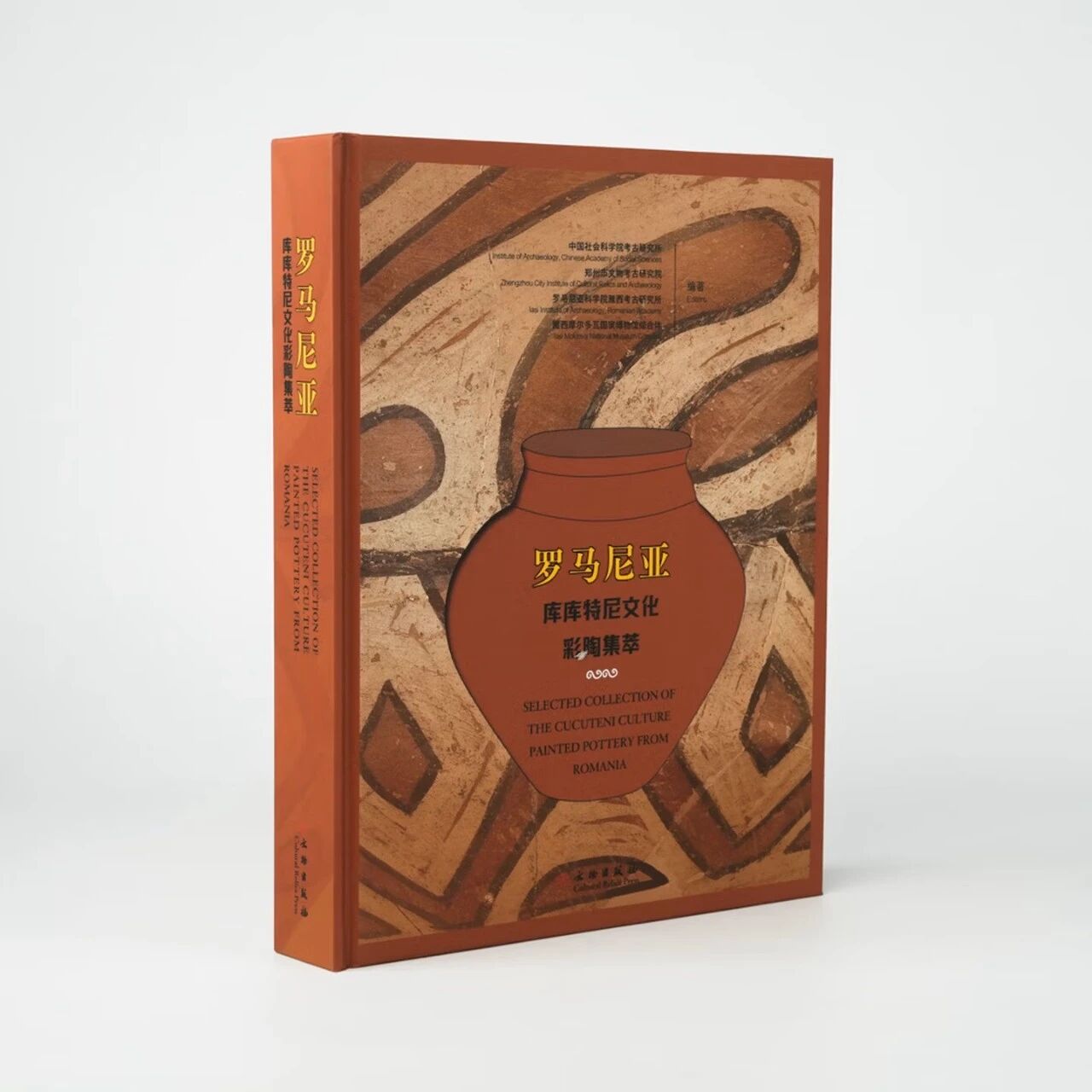
Since July 2019, the Sino-Romanian joint archaeological team conducted intermittent fieldwork over four years at the site of Dobrovăţ in Romania. This catalogue represents both an interim research outcome of the project and the first collaborative publication jointly produced by the Sino-Romanian team.
The publication of this Chinese-English bilingual catalogue of painted pottery was first proposed in May 2023 by Chinese Academy of Social Sciences, Institute of Archaeology researchers Chen Xingcan and Li Xinwei (currently Deputy Director of the Institute of Ancient History, Director of the Chinese School of Classical Studies at Athens). Its primary academic aim is to systematically introduce the Cucuteni culture—the pinnacle of prehistoric painted pottery in Romania—and its representative artifacts to the Chinese archaeological community. The proposal received immediate and enthusiastic support from Romanian collaborators, including Professor Magda Lazarovici, Senior Researcher I at the Institute of Archaeology, Iaşi Branch of the Romanian Academy, and Dr. Lăcrămioara Stratulat, Deputy Director of the Moldova National Museum Complex in Iaşi. These two specialists coordinated with museums in Iaşi and neighboring counties to select and finalize a list of representative painted pottery artifacts.
Following preliminary evaluations, approximately 200 exceptional artifacts were chosen, primarily from six museums across five counties in Iaşi and the vicinity—Bacău, Botoşani, Vaslui, and Neamţ—largely covering the core distribution area of the Cucuteni culture on the Moldavian Plateau. Regrettably, the Cucuteni Neolithic Art Museum in Piatra Neamţ (Neamţ County), a key institution for Cucuteni culture research, could not contribute its collection as its most exquisite pieces were on loan to Timişoara for the exhibition “Apogeul artei preistorice europene—Cultura Cucuteni” (“The Cucuteni Culture: The Peak of European Prehistoric Art”). However, a catalogue of the same title was published in late 2023 (Constantin Preoteasa. 2023. Cultura Cncuteni: apogeul artei preistorice europene: catalog de expoziţie. Piatra-Neamţ: Editura “Constantin Matasă”).
Following joint confirmation of the artifact inventory by Chinese and Romanian teams, photographer Wu Cheng-lung and photography assistant Wu Fan were commissioned to travel to Iaşi, Romania, from August to September 2023 to conduct photographic documentation of those artifacts. Their work was warmly supported by colleagues from each museum,and the resulting high-quality images in this catalogue are a testament to amicable Sino-Romanian collaboration. Mr. Wu also undertook meticulous post-production editing, for which we express our profound gratitude.
From October 2023 to February 2024, Professor Magda Lazarovici coordinated a team of museum professionals to draft artifact descriptions. The texts were preliminarily translated from Romanian into English by Ms. Simona Postolache and initially proofread by Professor Magda Lazarovici. Contributors included Ms. Lăcrămioara-Elena Istina of the “Iulian Antonescu” Museum Complex in Bacău; Mr. Mircea Oancă of the “Vasile Pârvan” Museum in Bârlad; Mr. Aurel Melniciuc and Ms. Adela Kovacs of the Botoşani County Museum; Ms. Senica Ţurcanu and Ms. Loredana Solcan of the Moldavian History Museum in Iaşi; and Mr. Alexandru Constantin Ciobanu and Mr. Albert-Gabriel Grecu of the Vaslui County Museum. Ms. Ramona Maria Mocanu and Mr. Ciprian Lazanu from the Vaslui County Museum also provided revisions to the descriptions. Dr. Kirie Stromberg of the Archaia Program for the Study of Global Antiquity at Yale University proofread and edited the English text to ensure academic precision. Dr. Wen Chenghao of the Institute of Archaeology, Chinese Academy of Social Sciences, managed coordination, Chinese translation bilingual proofreading, and formatting. Ms. Sun Dan of the Cultural Relics Publishing House oversaw graphic design, layout, and the entirety of the publication process, ensuring the catalogue’s high-quality production.
As this project neared completion, Professor Gheorghe Lazarovici—a core member of the Sino-Romanian team—passed away unexpectedly, leaving behind his cherished work on the Dobrovăţ project. Professor Lazarovici contributed invaluable insights during the catalogue’s preparation and co-authored its introductory section. This publication is hereby dedicated to his enduring legacy as a titan of Romanian prehistoric archaeology.