Abstract
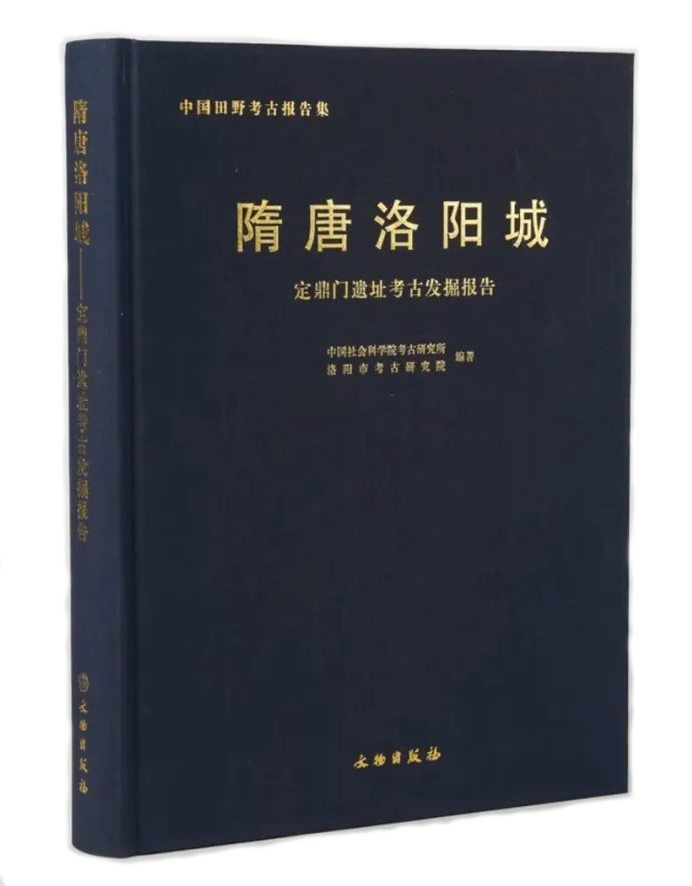
This book is part of a series of archaeological excavation reports on the site of the Sui-Tang Luoyang City, focusing specifically on the introduction and study of materials from the excavations of the Dingdingmen (Dingding gate) site. The fieldwork was jointly carried out by the Luoyang Tang City Team from the Institute of Archaeology, Chinese Academy of Social Sciences, and the Luoyang City Culture Relics and Archaeology Research Institute during two large-scale excavations conducted in 1997-1998 and 2007-2008. These investigations thoroughly revealed the layout, structure, and developmental evolution of the Dingdingmen site.
Dingdingmen served as the principal southern gate of the outer city wall of the Sui and Tang capital, Luoyang. Facing south toward Longmen/Yique (gate of the Yi River), it was aligned to the north with the Dingdingmen Street, Duanmen (the main gate of the Imperial City), Yingtianmen (the main gate of the Palace City), Mingtang (the main hall of the Palace City), and Longguangmen (the northern gate of the Palace City), together forming the central north-south axis of the capital. This alignment is of major significance in the history of Chinese capital city planning.
Originally constructed during the Sui dynasty, Dingdingmen continued in use through the Tang, Five Dynasties, and Northern Song periods. It underwent several large-scale reconstructions and renovations. In architectural terms, the complex was a monumental ensemble, centered on a three-passageway, beam-supported gate structure, flanked by watchtowers (duolou) and interconnected with defensive walls. Excavations have revealed architectural remains including gate passages, gate platforms (duntai), watchtowers, horse ramps, water culverts, the southern wall of the outer city, as well as north-south and east-west roads extending outside the gate.The overall layout of Dingdingmen remained fundamentally consistent from the Sui to the Northern Song period.
From the Sui dynasty, the only extant remains are the rammed-earth walls connecting the gate platforms and watchtowers, the rammed earth structure of the watchtowers and the city wall. The gate platform of this period was smaller in scale than that of the Tang dynasty, with a recessed base measuring 2.4 meters on both the east and west sides, and a total length of 39 meters. Its north-south depth was subsequently obliterated by Tang-period construction. The connecting wall between the gate platforms and watchtowers was approximately 5 meters in width. Each watchtower measured about 16meters (east-west) and 12 meters (north-south). The southern wall of the outer city of the Sui dynasty was only 2.2 meters in width. On the eastern side of the east watchtower, a brick-built water culvert pierced the city wall. This feature corresponded to the depth of the wall, measuring 0.62 meters in span and 2.2 meters in depth, and incorporated an internal brick partition wall designed to divert the flow of water.
In the early Tang dynasty, Dingdingmen retained the same beam-supported, three-passageway configuration. Architectural remains recovered from the gate passages include stone bases and pivot stones. The partition walls separating the passages each measured 5.6 meters in width, while the passages themselves extend to a depth of approximately 21 meters. The gate platforms flanking the passages were about 8 meters wide. Horse ramps located on both sides measured 4.7 meters in width and were preserved to a length of 22 meters. The distance between each watchtower and its adjacent gate platform was approximately 33 meters; the watchtowers themselves measured 16 by 12 meters. A stone-built culvert, 2.3 meters wide and 3.1 meters deep, pierced the western wall adjacent to the west watchtower. At the center of the culvert was a spindle-shaped stone divider, which separated the channel into two sections, each about 0.83 meters wide. At this stage, the wall of the outer city measured 3 meters in width.
In the late Tang period, the overall layout and scale of Dingdingmen remained largely consistent with those of the early Tang. A notable modification, however, was that the watchtowers no longer projected beyond the north face of the city wall, but were instead set flush with it, thereby assuming a form comparable to gate flanks or bastions (mamian).
During the Five Dynasties and Northern Song periods, the gate underwent minor modifications to the Tang layout. The gate passages became narrower yet deeper, with both the passages and the partition walls measuring 4.8 meters in width and extending to a depth of approximately 23 meters. The watchtower structures flanking the gate platforms, which had appeared as duolou in the Tang period, were abandoned and replaced by mamian. At this stage, the city walls were widened to about 8 meters.
In the late Northern Song period, the Dingdingmen largely retained its established form, comprising a beam-supported, three-passageway gate structure with associated gate platforms, passages, partition walls, city walls, horse ramps, and a surrounding moat.
Multiple layers of silt and charcoal were discovered within the Dingdingmen site, indicating catastrophic events, specifically conflagration and flooding during the period of its occupation.
This report also includes documentation of related remains such as the city walls, roads, tombs, and recovered artifacts from the Dingdingmen site.
The southern wall of the outer city was found to be notably thin, measuring 2.2 meters during the Sui dynasty and 3 meters in the Tang, corresponds with historical records that “the Sui had only short city walls.” The central street (tianjie) inside the Dingdingmen was about 140 meters in span, while the north-south road outside the gate was about 147 meters wide, aligning closely with historical accounts referring to “a width of approximately one hundred paces.” Moreover, the late Tang Road surface south of the gate site preserved a dense assemblage of wheel ruts, human footprints, and animal hoof prints, with a significant frequency of camel tracks. This evidence offers a vivid testament to the bustling activity and economic vitality of Luoyang during the Sui and Tang periods.
This report is a specialized volume within the broader excavation series of the Sui-Tang Luoyang City sites. It holds significant academic value for the study of the spatial layout,architectural features, administrative systems, and social life of medieval Chinese cities.